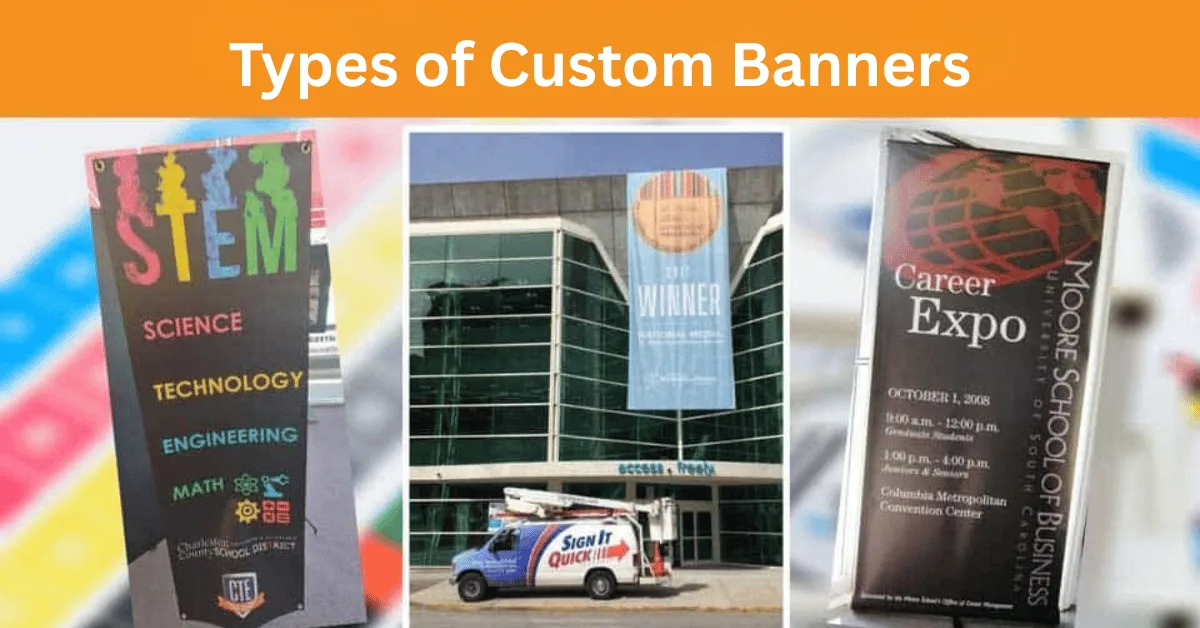
Picking a banner comes down to three questions: Where will it go indoors or out? How long does it need to last? And how often will you move it? Answer those, and the right material and format usually pick themselves.
Here’s a straight comparison of the eight banner types businesses use most, what each one actually costs to run, and where it falls short.
Quick comparison
| Banner Type | Best For | Indoor/Outdoor | Reusable? | Typical Cost |
|---|---|---|---|---|
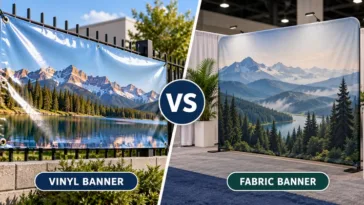
| Vinyl | General advertising, storefronts | Both | Yes, for years | $6–10 per sq ft |
| Mesh | Windy or exposed sites | Outdoor | Yes | Slightly more than vinyl |
| Fabric | Conferences, showrooms | Indoor (mostly) | Yes, washable | Higher than vinyl |
| Retractable Stand | Trade shows, presentations | Indoor | Yes | $120–250 per kit |
| Pole Banners | Streets, light poles, event routes | Outdoor | Seasonal reuse | Similar to vinyl |
| Hanging Banners | Malls, ceilings, large indoor spaces | Indoor | Yes | Similar to vinyl/fabric |
| Feather Flags | Curbside, storefronts, outdoor events | Outdoor | Yes | $80–150 with pole/base |
| Step & Repeat | Photo backdrops, press events | Indoor (mostly) | Yes | Higher, size-dependent |
1. Vinyl banners — the all-purpose default
Vinyl is PVC-based, which is why it holds up outdoors: rain, sun, and rough handling don’t damage it easily. It’s also the cheapest option per square foot, which is why it’s the default choice for storefronts, trade shows, and short-term promotions.
Good fit if: you want one banner that works both indoors and outdoors and don’t want to think too hard about it.
Skip it if: you need something that looks premium up close — vinyl has an obvious “printed plastic” texture.
2. Mesh banners — for anywhere the wind hits
Mesh is vinyl with small holes punched through it, so wind passes through instead of catching the banner like a sail. That’s the entire reason it exists — a solid vinyl banner on a fence or building wrap will tear or rip its grommets out in a strong gust; mesh won’t.
Good fit if: construction site wraps, fence banners, building facades, anywhere air needs to move through.
Skip it if: the banner will be viewed up close — the perforation slightly softens image sharpness compared to solid vinyl.
3. Fabric banners — the premium indoor option
Made from polyester or satin, fabric banners don’t have glare the way vinyl does, so colors read cleaner under indoor lighting. They fold instead of creasing (a real crease permanently damages vinyl) and can be washed and reused.
Good fit if: trade show booths, conference backdrops, retail displays — anywhere brand polish matters more than budget.
Read the full comparison: Why Businesses Are Switching to Fabric Banners for Marketing
4. Retractable banners — grab-and-go for events
A retractable banner is a printed graphic that rolls into a base unit, so setup is: pull it up, lock it, done — usually under a minute, no tools. The tradeoff is a fixed width (almost always 33″ or 47″), so you can’t customize the size the way you can with vinyl or fabric.
Good fit if: you attend multiple events a year and need something that survives repeated packing and setup.
Read the full guide: Retractable Banners: Types, Sizes, Uses & Buying Guide
5. Pole banners — for streets and event routes
These hang from light poles or dedicated banner poles using pole pockets on each end, usually seen along main streets for city events, festivals, or seasonal campaigns. They’re built for outdoor exposure over weeks or months, not a single afternoon.
Good fit if: city-wide event promotion, seasonal campaigns, downtown business districts.
6. Hanging banners — for ceilings and open indoor spaces
Hanging banners solve a specific problem: you want visibility in a big indoor space without using any floor space. They’re mounted from the ceiling with grommets or pole pockets and are common in malls, expo halls, and gyms, often printed on both sides so the message reads from any direction.
Good fit if: you need visibility across a large indoor venue and floor space is limited or valuable.
7. Feather flags — for outdoor foot traffic
Tall, curved flags on a flexible pole that move with the wind, which is exactly why they work — the motion catches attention from a distance in a way a static banner can’t. They’re lightweight, pack down small, and are the standard choice for curbside promotions, farmers markets, and grand openings.
Good fit if: you need to be seen from the road or across a parking lot, not just up close.
8. Step and repeat banners — for photos and press
Built from a repeating logo pattern, these are designed to be photographed, not just seen — every picture taken in front of one becomes free brand exposure. They’re standard at press events, product launches, and red-carpet-style photo ops.
Read the full guide: What is a Step and Repeat Banner: Complete Guide for Events
How to choose in 30 seconds
- Outdoors and budget-conscious: vinyl
- Outdoors and windy: mesh
- Indoors and want a premium look: fabric
- Traveling to events often: retractable
- Promoting along a street or event route: pole banners
- Big indoor venue, no floor space: hanging banners
- Need to be seen from a distance outdoors: feather flags
- Need constant photo/press exposure: step and repeat
What size do I need?
Size depends on viewing distance more than anything else — a banner meant to be read from a car needs much larger text and dimensions than one at eye level indoors. See our full breakdown: Standard Banner Sizes Explained
Frequently Asked Questions
What’s the most durable type of banner?
Vinyl and mesh are the most weather-resistant, since both are built from PVC designed for years of outdoor exposure.
Which banner type is best for a one-day event?
Retractable banners or feather flags — both set up in minutes and pack down small enough to store easily between uses.
Can I reuse a custom banner?
Yes, most types are reusable. Vinyl and mesh hold up to repeated outdoor use, fabric banners can be washed, and retractable banners are specifically built for repeated setup and teardown.
What’s the cheapest banner option?
Vinyl is generally the lowest cost per square foot while still holding up outdoors, which is why it’s the most common choice for straightforward advertising.
Do I need a different banner for indoors vs. outdoors?
Not always, but it helps. Vinyl works in both settings. Fabric and step-and-repeat banners are built primarily for indoor use, while mesh and pole banners are made specifically to handle outdoor conditions like wind.

 No products in the cart.